DBSA Omaha New Hope
Depression & Bipolar Support Group, Omaha NE

Taking Care of Yourself While Taking Care of Others – 8/25 meeting
Last Thursday we were treated to Brett’s first presentation with us, entitled “ Taking care of yourself while taking care of others”
Brett began by sharing that we eventually need to set boundaries to take care of ourselves, while you are taking care of others. Brett shared his life story with us. About 30 years ago, Brett was just out of college and working overtime to make ends meet. It was around this time that Brett ended up in the ER with severe cluster headaches, which turned out to be a result of too much caffeine intake, and not drinking any other liquids. It was during this time he realized this was a result of paying too much attention to others needs, rather than his own. Eventually he began to over extend himself, and he was also drinking too much, which resulted in the loss of his job. It was also during this time that things started to spiral even more.
He started to realize that he truly wasn’t taking care of himself, but was still afraid to ask for help, even at his job. Reaching a new low point, he finally reached out to a therapist for help. This was the first real step he would take for his mental health. It was during this time that he also ended up in a hospital for care of his mental health. During his stay he was eventually assigned a therapist and psychiatrist. Brett shared the worst part of his stay in the hospital was the loss of many of his friends. Most of his friends just couldn’t support his mental health diagnosis. After his release from the hospital, he was able to keep his job. But soon after he stopped seeing therapists and quit taking his meds. During this time he got to the point where he had racing thoughts constantly, and he didn’t really seem to be enjoying the life he had.
In 2019, while Brett was struggling, he would wear the same clothes for weeks at a time, and not take showers for several days. It was during this time he did end up in the hospital again for some treatment. Finally during this stay Brett did end up with the right help and skills to decide what steps he needed to actually take to get through life. After his successful stay in the hospital, Brett finally took the first vacation he had taken in several years.
Over the past three years, Brett feels that he has really tackled his mental health head-on, and he feels like he is living his “best life” , more than he’s lived in a long time. Bravo for you Brett!
Brett ended with sharing with us some quotes he had run across that are very meaningful to him.
First a thoughtful quote by Kennith Allen Thomas;
“ Stop braking promises to yourself, remember what you set out to do, and complete the mission “.
And other meaningful quotes:
“ The deepest pain I ever felt was denying my own feelings, to make everyone else comfortable “.
“ Sometimes you don’t realize how much you’ve neglected yourself, until you make yourself a priority again “.
100 Things – 8/18 meeting
Last Thursday we were treated to Kirk’s most recent presentation with us entitled “ 100 Things “
Our friend Kirk shared that normally around this time of year, he tries to make New Year’s resolutions, but he doesn’t necessarily stick with those resolutions.
But Kirk did share with us several things that do help him to improve his life.
1) Exercise! He suggested with exercise to keep it realistic, and to start out by picking one day a week to choose to exercise. Kirk shared that in seven months time he has lost 15 pounds! Awesome work Kirk!
2) Buy a plant, or plant something that you have to care for. In addition, planting something may possibly help you with your depression during the Winter time.
3) The cell phone…something that we all can’t seem to live without.
Kirk suggested when texting a friend, try sending them a “ voice note” rather than a text message. That way it’s not so impersonal. Or trying to actually pick up the phone and make a phone call to that friend, wouldn’t that be a surprise!
4) Are you feeling a little sluggish at work? Kirk suggested trying to use the Pomodoro technique. The Pomodoro technique is a time management tool created by Francesco Cirillo. With this technique you use a timer to break work into 25 minute intervals, with a five minute break in between. This method may actually help with ADHD.
5) Make a daily list , or ADL’s. ( activities of daily living) Kirk shared that he tried this for awhile, and it seemed to help. With this idea, you make a daily list of tasks you need to accomplish, and scratch the items off as they are completed.
6) Be nice to rude people! If you encounter a rude person, try and change the narrative. This may actually turn around the situation. This may prove challenging, but give it a try!
7) Try cooking something…or try and cook something new you’ve never cooked before.
8) Nap time..Kirk shared as an adult he has learned to appreciate the time spent taking a nap.
9) Set aside an hour a day to do something you truly enjoy!
10) Try and make a friend from a different generation.
11) Go out and connect with nature, maybe try taking a walk.
These are all amazing ideas that were shared by Kirk with everyone.
Amazing presentation Kirk!
Small Town Living – 8/11 meeting
Last Thursday we were treated to Haley’s first presentation with us entitled
“ Small Town Living “
Haley shared with us she grew up in Alliance, which has a population of approximately 8,000. She wanted to share with us what it was like to live in a small town, if you happen to be someone experiencing mental health issues.
She also shared that there were many pros and cons of living in a small town.
And statistics state that there are only 3 psychiatrists for every 100,000 in population, which meant that Alliance most likely did not have more than three. Statistics also state that there are higher rates of addiction and the suicidal rates are higher in smaller towns. There is also a lot of stigma in a small town if you have mental health issues, something we are all familiar with.
Haley mentioned that many psychiatric practices end up closing and move into hospitals, where they started to lose that personal touch. For awhile the psychiatrists offices in hospitals in small towns only consisted of a couple of folding chairs in a room, but apparently those conditions have improved somewhat in recent years.
People in small towns also seem to get discouraged in the small town setting, and tend to seek out their regular General Physician for help rather than a psychiatrist. This option may not be the greatest, as truly it is best to have a regular psychiatrist to help you with your mental health needs.
During a recent study of 500 people over the age of 60, 478 of those 500 were found to believe the mental health stigma that is so common these days.
In a small town there are many businessmen who are farmers, and even though these folks may need mental health assistance, they usually cannot afford the help. Many of them may be struggling financially and may also be on Medicare or Medicaid, with little to no coverage. Also most who live in a small town, and who happen to be struggling with mental health issues, have so much shame for their feelings that they are afraid to seek help.
For a long time there was a big lack of education on mental health, and many teachers were not educated on mental health issues. However things are starting to change a little bit for the better.
Haley shared that a school district in western Nebraska has now started to come together and has now budgeted every year for mental health care.
Every Summer a Doctor in this area hosts teens from across the state to take part in FARM camp. High school students attending this camp can take a class for college credit, receive education on psychology, and hear from mental health professionals . This program helps to educate teachers and parents on mental health. Haley also noted that 78 counties in Nebraska have no psychiatrists, so this is a great way to help fulfill that need!
Defeating your Inner Critic – 8/4 meeting
Last Thursday Steve shared with us his most current presentation,
“ Defeating your Inner Critic “
Steve began by sharing his definition of your inner critic. Does this inner voice dictate your daily actions, and use hurtful judgments about your abilities and your worth? If so, this may be your inner critic talking. Normally your inner critic is formed from painful experiences you may have had when you were younger.
Maybe this inner voice tells you;
1) that good outcomes only happen because of good luck, and maybe bad outcomes mean that you are not good enough?
2) your date didn’t go well because you’re not interesting, and who wants to be with you anyway?
3) You will never be good enough, no matter what you do.
This inner voice has a harshness, which we only seem to use on ourselves. This inner voice doesn’t offer to us the kindness and consideration that we would normally give to our best friend. Usually our inner critic does not motivate us. A voice of encouragement motivates us. Self-compassion motivates us. This inner critic may be holding you back from moving forward.
So, how do we fight off this inner critic? The key may be curiosity. We can embrace curiosity, since it loves to notice everything. If you use curiosity, you can look more non-judgmentally at your inner critic, and ask questions like;
-how did this voice develop?
– when did this inner critic start?
– When did this inner critic come out, and when does it go away?
– Does this inner critic serve a purpose?
Can an inner critic be helpful?
Some believe that an inner critic can be used to avoid an embarrassing situation. But it could also encourage you to move forward and succeed.
As an example, I had a situation about two years ago, where I decided on a whim to join my church choir. Now realizing at the time that I have had no previous singing experience, in a choir or elsewhere, my inner critic came into play. That inner voice was telling me, “ you fool, why would you join a choir? You can’t sing! What are you thinking? “ Thankfully, I didn’t listen to my inner critic. Today I am still a part of my church choir, and enjoying every minute.
And I learn something new every time I sing.
Unfortunately the inner critic never really disappears. But there are things you can do that will teach your inner voice to be kinder, more like a coach rather than a critic.
1) try to identify your inner critic…see if you can figure out what your inner critic is telling you. Remember that this is not your real point of view.
2) try using humor to cope with your inner critic. Try imagining your inner critic’s voice as that of an animated character you cannot stand.
3) acknowledge and accept your inner critic..accept that your inner critic will not disappear, however we can change how we react to it. Maybe try and come up with different coping techniques to change how you feel when your inner critic surfaces.
Coping techniques for your inner critic;
Meditation…try meditation to be more mindful. Usually meditation will help you to become more mindful, and recognize your negative thoughts before you invest too much time in them.
Don’t compare yourself to others..easier said than done, but try to stop looking outward, and look inward. Instead of comparing yourself to others, try only comparing yourself to the old you. Don’t give any time to comparing yourself to others, which your inner critic thrives on. Just focus inward and how you can improve you!
Self-compassion..try to remember that we are not perfect, and accept that.
Remember try to be kind to yourself if you feel you have failed or during a difficult time. Practicing self-compassion will help to build your confidence.
Self-gratitude journal…so every day, try writing down one thing about yourself that you’re grateful for. This is actually positive self-talk, or even a form of self-compassion. If you tend to compliment others, shouldn’t you also compliment yourself?
Don’t ignore your instinct….remember your initial thoughts about a situation are probably correct. Don’t second guess yourself. Learn to trust your own instincts!
Positive affirmations to quiet your inner critic:
Love myself at all times…when you try and practice self-love, you will become more accepting of yourself, and your inner critic will probably come out less.
I am my best friend..The old saying “ treat yourself as you would want others to treat you “ applies here.
I learn from my mistakes..with this one, try and not focus on a mistake you may have made. Rather than letting your inner critic beat you up on this one, just try and learn from your mistakes and move on.
I am doing my best..this is an important one to use against your inner critic. All throughout life, this one will remind you that you are doing your best, and there’s nothing more you can do.
I am not perfect…no matter how hard we try, we won’t make it through life without making mistakes. Remember you are not perfect. Try and use this affirmation often, and add your own message..something like “ I’m not perfect, and I’m doing the best that I can! “
Channeling your Thoughts through Art – 7/28 meeting
On Thursday July 28th, Carolyn offered her presentation entitled “ Channeling your Thoughts through Art”
Carolyn began by sharing her story about her hospital stay of some years ago. During the time leading up to her stay in the hospital, she had trouble trusting others and was dealing with a lot of paranoia. It was during this time that she didn’t want to see anyone. Finally with some encouragement from her daughter, she was admitted to the hospital for some help. It was during her stay in the hospital that her daughter brought Carolyn some art supplies, to help her pass the time.
During her stay in the hospital, Carolyn experimented with her art talents, and became very inspired. It was during this time that Carolyn’s imagination would also inspire her to create art. She had discovered that we need to look for things we might enjoy. While in the hospital, Carolyn came to the conclusion that most people are really not lazy, that they are probably just uninspired.
Carolyn’s co-presenter for the evening, Don, shared with us a little information about the infamous phrase “ right brain vs. left brain “ He shared that usually right brained may be people who use their imagination more, and tend to be more creative and involved in the arts. Whereas left brained people may be more analytical and logical, and interested in the facts. Don shared that the left side of our brain controls the right side of our body, and the right side of our brain controls the left side of our body. Don said that ideally a person would want to be somewhere in the middle, and occupy both sides of our brain. He then demonstrated by playing us some music. First the “left side” by playing exactly what was on the sheet of music, using math and language skills. He then played the exact same song after engaging the creative “right brain”. This made a huge difference as the music became much more musical and less mechanical. The bottom line to what Don was telling us is by playing music, both sides of our brains are engaged, providing a great escape from living in our heads!
Carolyn shared that during this hospital stay, she felt that her treatment was working, as she was beginning to trust people again. Carolyn said that the art that she produced during her hospital stay gradually changed during that time, and she became more creative. She felt that being in the hospital was a good option, as she learned different ways to cope. Eventually Carolyn became very grateful and humble for her hospital stay.
Carolyn did share with us many of her art pieces that she created during her hospital stay. Carolyn is a very talented artist indeed! I’m grateful that she so kindly shared her artwork with us.
Imperfect Success – 7/21 meeting
Last night we had a unique presentation, co-presented by Miriam and Don on “Imperfect Success” Don started out by asking us, “What did you want to be when you were 5?”
The point was, we all wanted to be something different when we were five, and like in that example, what we define as success changes as we grow older and hopefully wiser. We also start seeing the success does not have to be perfect. It can be a step along a path. It can be something only you value. Don pointed out, some of our greatest successes are things that mean nothing to others or are not even noticed by others.
Miriam took over and we talked about definitions of success including:
What success isn’t – what other people think.
What other people think success is for them
What other people think success is for you
Don continued with pointing out that we need to recognize that there are many parts of our life we can be successful in and they are not always tied together. We then talked about defining areas of life we can be successful in, such as personal, family, social, and career success.
Miriam then talked about obstacles to succeed in our lives including depression, anxiety, our sometimes dysfunctional families, and lack of family support.
Don and Miriam then both shared what they thought were their life successes.
The meeting wound up with Don asking the group “What is your biggest success?”
What did you overcome to get there?
What were the little successes along the way.
What did you learn from those little successes along the way?
What did you do today that was a success?
We all have successes every day, some big, some little. As imperfect as they are, they are our successes. Even if nobody else notices them. What mountain are you going to climb tomorrow? What is going to be your next success?
Pride Festival 7/16
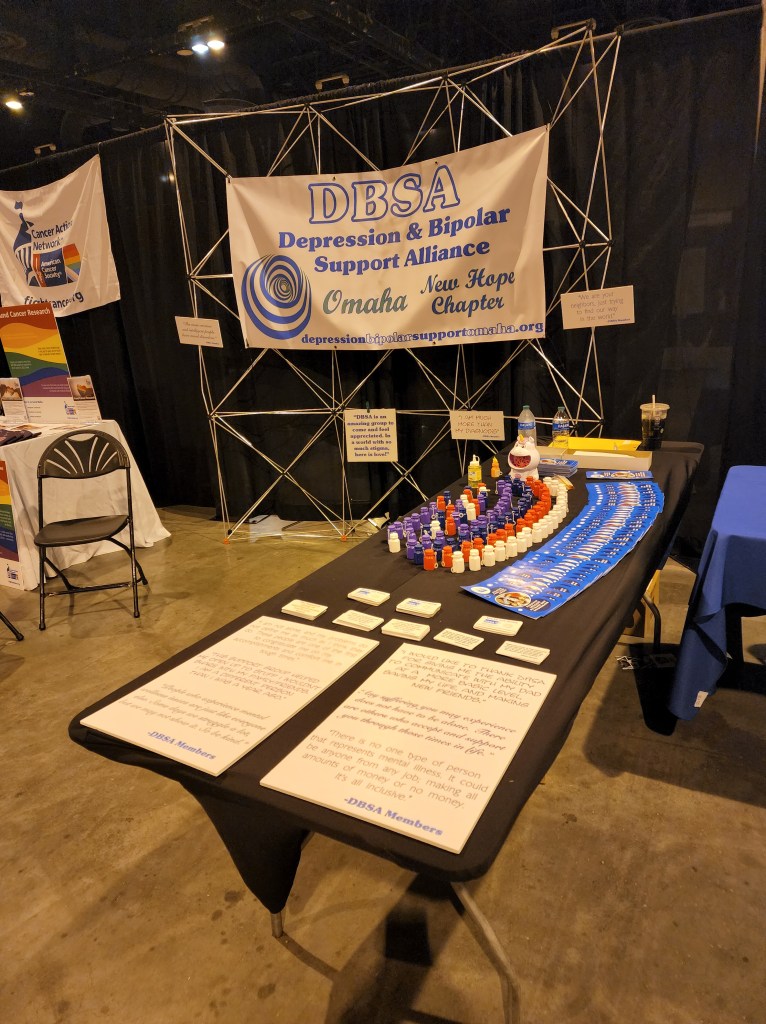
We were excited to participate in this year’s Pride Festival at CHI this past Saturday. Our seven volunteers met and handed out information to over 1200 attendees. The best part was the sincere interest and gratitude we felt. What a great event and we hope to see some of our new friends at a Thursday night meeting soon!
Knowing Yourself – 7/7 meeting
On Thursday July 7th, Don gave us his most recent presentation entitled “ Knowing Yourself “
Don began by asking us Who are you? What makes us who we are ? He advised that we all have triggers, what are yours? Volunteers from around the room offered their triggers, mine happens to be fireworks. First thing that came to mind. Others mentioned loud voices, and people yelling. We all have different triggers. Don went on to share how music has been and still is a huge force in his life. He said music allows him to express his inner voice.
Don shared that 31 years ago he was at rock bottom. He had recently lost his treasured business he had built with trusted friends. However one of those trusted friends helped to bring the business down. This was a shock and a very tough time in Don’s life. He shared lately that he feels like a dark hand is trying to reach him, grab him, and drag him back to his past.
So must of us are familiar with our bad triggers. But are all triggers bad?
How do we determine what our good triggers are? Don went around asking the room what their positive triggers were. My positive trigger is chocolate brownies, one person mentioned a certain beach in Florida, another mentioned the smell of fresh baked bread.
Don suggested to come up with your own playlist of your favorite songs, and use this playlist as a positive trigger. This in turn will bring out positive feelings.
Have a positive playlist ready for those difficult low moments. Sometimes, somehow just derailing our negative thoughts can help make a big difference! Knowing yourself, and how you react to certain triggers is an important item to have in your tool box.
With that, Don actually gave us a homework assignment from this presentation, which I am ready to try. He advised us to write down 4 or 5 items you have with you all the time, that are positive triggers in your life. I plan on trying this! Can’t wait to give it a try!
A long time ago… 6/30 meeting
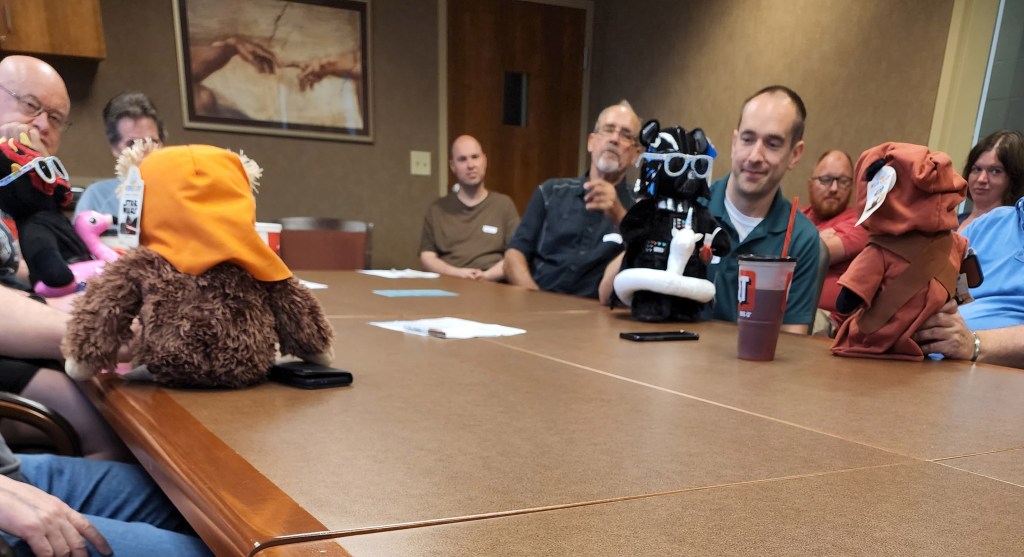
At our June 30th meeting, we were transported to a long time ago, in a galaxy far far away, as Don, wearing a full Jedi costume, looked at mental health through the eyes of a Jedi.
When we take a step back and really look at Star Wars, we find the George Lucas had done his homework. All the fun and explosions had been built on a chassis that carried so much more. The further we got into Star Wars, the more we heard of this thing called “The Force”. “The Force” is really a combination of many religions, and myths, with a large dose of historical values. It is storytelling built on a well thought out, rich moral code.
When we get to the second movie, we are introduced to the most unlikely of great warriors, Yoda. But Yoda is much more than a warrior, he is the moral center of the story. He is the philosopher, the high priest, the unassuming core of what makes Star Wars tick. We found Yoda teaches many of the same things we talk about here every Thursday night. Things like self confidence, fear, failure, choice, darkness, the future, the force, your role in the world, and even the value of community.
Don then took us through about 20 of Yoda’s most famous quotes and analyzed them based on how they apply to mental health, and specifically, us.
While many of the quotes brought us thoughtful and sometimes fairly dark subjects, there was also the story of the Ewok and Jawa acted out with Star Wars Build a Bears with help from everyone in attendance! The story illustrated Yoda’s quote “Do or do not, there is no try”, featuring the two fearsome Sith lords in pool floaties and sun glasses! Hard to explain in a blog, you just had to be there.
Herding Cats – 6/16 meeting
On Thursday June 16th, Miriam gave us a presentation entitled; “ Herding Cats”
I have to begin by saying, I love the title of Miriam’s presentation. It puts a smile on my face. That aside, Miriam described Herding Cats as, the difficulty of getting people to agree on anything. The harder you try, the more frustrating and impossible it may become. For example when ordering a pizza or two to be delivered, it can be difficult to get everyone to agree on the same toppings. Miriam also described a recent situation when her family had gathered together for her Father’s memorial service, where she could not get several Aunt’s and Uncle’s to agree together on the same restaurant for dinner. In fact once they decided where to meet, some of her relatives couldn’t find the restaurant. Miriam said she learned from that particular situation that it’s impossible to control the uncontrollable. Things sometimes will just collapse on their own and transcend into a new level.
If this should happen to you in a given situation, it’s possibly a good time to fall back into your own safety net. Your initial assessment of the situation can determine your own reaction. If necessary, you may even want to step outside, get some fresh air, and gain some new perspective.
Miriam offered these steps to proceed:
1) determine your #1 priority
2) assess what needs to be done
3) prioritize
4) take inventory of your external and internal resources
– Internal resources can be your own life experiences, or just having the self-confidence to know you’ll come up with a solution to the problem.
– external resources may come from others in your group, who may be able to assist you in resolving the problem on hand.
In handling situations, we need to accept the imperfections in our lives, and realize there will be different approaches to handling problems.
It’s important in these situations to:
1) prioritize by urgency, or the size of the problem
2) determine what matters to you the most
3) realize every approach has risks/ consequences
4) control what you can control
So, how do we prepare for chaos in our own life?
1) be ready, try to stay relaxed and be resilient
2) learn to say no to people. After you’ve said no, ask others to help instead. Asking for help is a sign of strength, not weakness.
3) make time for hobbies and exercise
4) take time to “ wash out your brain and reframe your thoughts “
A challenge to take on;
Try writing down three things you’re grateful for every day, for an entire month. No repeats allowed. Sounds like a great exercise to me! I plan on trying this one.
A thought; try to remember that chaos causes us to adapt and change.
If you start to realize that you can’t predict the future, or control everything in your life, that can be very freeing! It’s important to adapt, and encourage yourself to stay resilient!
 DBSA Omaha New Hope